How a paper parking sticker became an accountable system
Eaton Square — Parking
Validating a customer's parking ran on a paper sticker — no record of who gave what, no way to hold a limit, nothing to reconcile at the end of the month. We replaced the sticker with a system, and left the parking machine alone. If a scrap of paper is the only thing tracking something you pay for, you're already losing money you can't see.
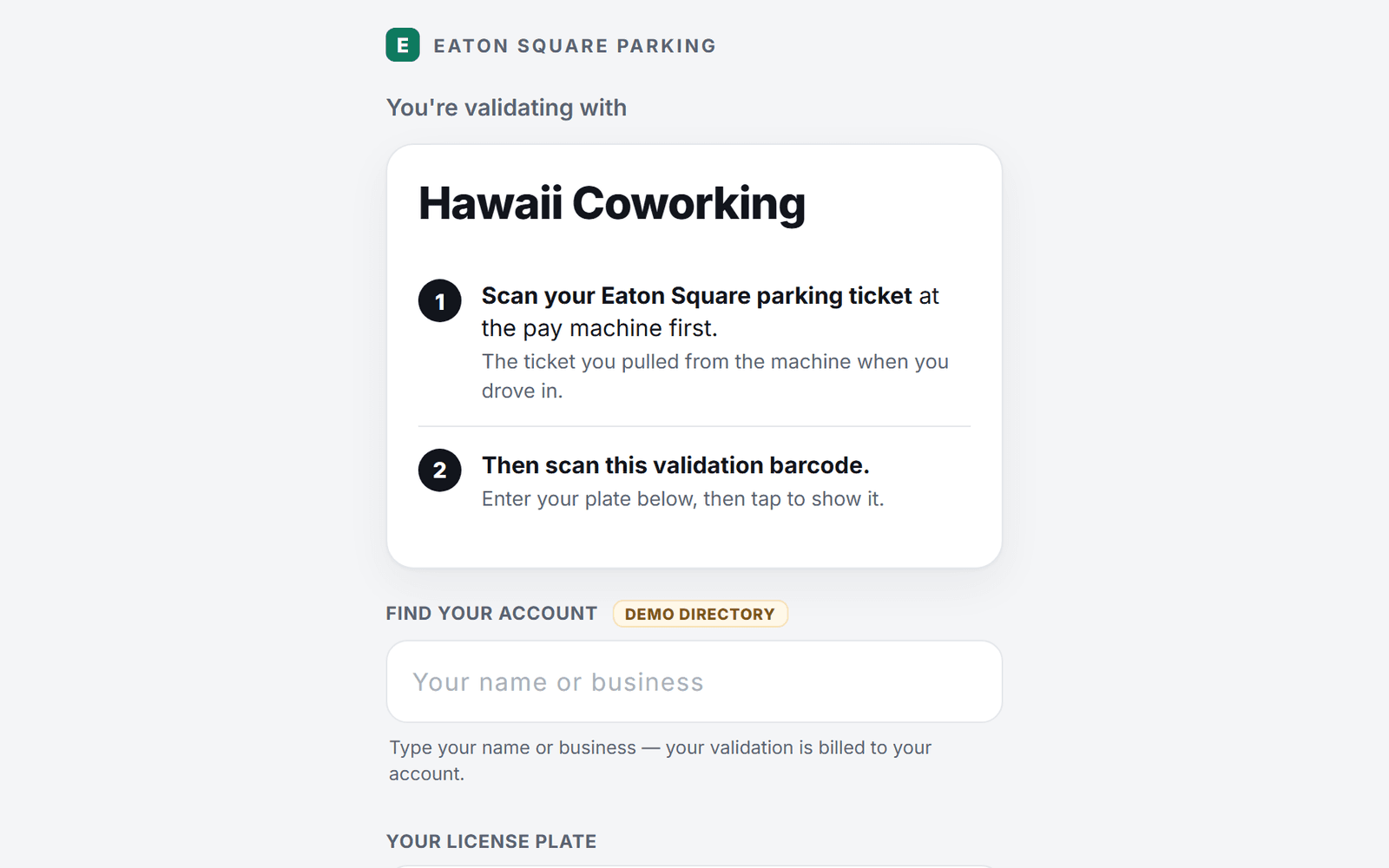
A business inside Eaton Square wants to cover a guest's parking. The way that worked was a paper sticker: someone at a front desk peels one off a sheet and hands it over.
That sticker is the entire system. There's no record of who handed out what, no limit that actually holds, and nothing to reconcile against at the end of the month. A sheet gets used up faster than expected and nobody can say why.
The parking machine itself works fine. The problem was never the garage — it was the piece of paper standing in for a process.
The sticker was the entire system.
The rule we set first was what NOT to touch. The garage's TIBA pay machine already issues tickets and takes payment, and rebuilding that would have been expensive, slow, and unnecessary.
So the build replaces exactly one thing: the sticker. The guest still pulls a ticket on the way in and still pays at the machine on the way out. Everything we added lives in between.
That boundary is written on the page itself, in plain language, so nobody expects the app to do something it deliberately doesn't.
It replaces the sticker. Nothing else.
No app to install, no account to make — a guest scans one code and follows two steps:
- 1Scan the business's QR code, displayed at their front desk
- 2Enter the license plate — it gets printed onto the validation
- 3Choose a validation from what that business actually offers
- 4At the pay machine, scan the Eaton Square parking ticket first
- 5Then scan the validation barcode on the phone
Every business gets its own validation page and its own QR code — printed or displayed wherever guests are standing.
Per-business pages
Each tenant has their own page, their own code, and their own validation tiers.
Live inventory
Tiers show what's left — 3 available, 10 available — and go SOLD OUT when they're gone.
Plate on the validation
The guest's plate is printed onto the validation, tying it to one vehicle.
Billed to the account
Validations bill back to the business that gave them out, so the month reconciles itself.
Tiers are set per tenant, because a bakery and a coworking floor don't need the same thing:
- —Hawaii Coworking runs the full ladder — 30 minutes, 1 hour, 2 hours, 4 hours, all day
- —Kulu Kulu Bakery offers 30 minutes, and nothing else
- —A salon can offer a single validation sized to an appointment
- —Each tier carries its own price and its own remaining count
- —When a tier runs out it says so, and tells the guest to check with the front desk
Validation barcodes arrive from the garage the way they always have: printed on physical sheets. Getting those numbers into the system by hand — one twelve-digit code at a time, hundreds of them — is the kind of job nobody does twice.
So the admin screen takes a photograph instead. Shoot a whole sheet or a corner of one and it finds every barcode in the picture and adds them individually, skipping any it's already seen.
The photo never leaves the phone. It's decoded on the device into numbers only, and the system generates its own clean barcodes from there for guests to scan.
Photograph the sheet. It reads every code on it.
Each batch of decoded codes is filed against the details that make it usable:
- —The business the sheet belongs to
- —The timeframe those codes are worth — 30 minutes through all day
- —The business name as printed on the sticker
- —The valid-from and valid-to dates
- —Duplicate codes, skipped automatically
A paper sticker can't be counted, can't be capped, and can't be traced to the business that handed it out. Everything about it is invisible until the bill arrives.
The same act now leaves a record: which tenant, which vehicle, which tier, and how many are left. Management can see it while it's happening instead of guessing afterward.
And the garage never changed. The machine that takes the money is the machine that always took the money.
The guest still scans a code and drives away. The difference is that now somebody knows what happened.
Want this kind of path for your business?
Start the Clarity PathSee what your business is missing.
Or book a 15-minute call